
Most people believe a will controls where their property goes. In Florida, a will controls where most of your property goes, most of the time, to most people. There is one significant exception, and it is the one that most often undoes the careful plans of people in second marriages.
Florida gives a surviving spouse the right to claim a share of the estate regardless of what the will says. The spouse does not have to prove anything. There is no showing of need, no argument about fairness, no requirement that the marriage have lasted any particular length of time. The spouse files an election, and the share is theirs.
Families discover this at the worst possible moment: after a death, when the adult children of a first marriage learn that the house they expected to inherit is subject to a claim by someone they may barely know.
The Rule in One Sentence
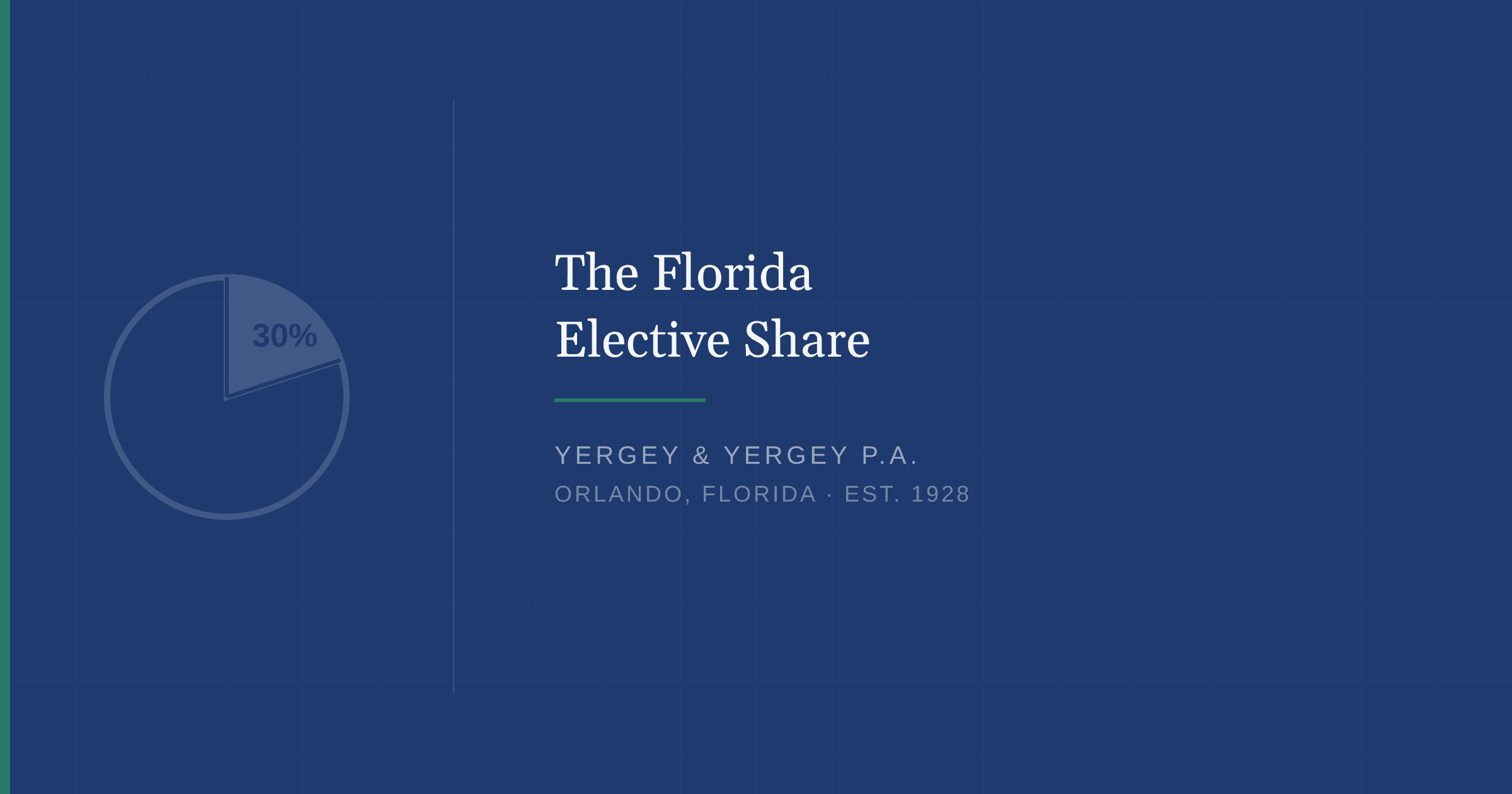
Section 732.2065 of the Florida Statutes provides that the elective share is an amount equal to thirty percent of the elective estate.
That is the entire rule. Thirty percent, elective estate, surviving spouse. What makes it complicated is the second phrase.
What Counts as the "Elective Estate"
If the elective estate were simply the probate estate, avoiding the elective share would be trivial — put everything in a revocable trust, name beneficiaries on the accounts, and the probate estate is empty.
Florida anticipated that. The elective estate is defined broadly and reaches well past probate. It includes, among other things, the decedent's probate estate; property held in a revocable trust; accounts and property held in a form producing survivorship rights; property held in payable-on-death and transfer-on-death form; the net cash surrender value of life insurance the decedent owned; amounts in retirement plans; and certain property transferred within one year of death.
The practical effect is that most of the standard workarounds do not work. A revocable living trust is an excellent probate-avoidance device and it is not an elective-share-avoidance device. Neither is retitling accounts, and neither is naming the children as beneficiaries.
Because the definition is technical and the calculation involves valuation and offsets — the surviving spouse is credited with what they already receive from the estate and from non-probate transfers — the elective share is one of the areas of Florida probate practice where a lawyer's arithmetic and a family's arithmetic routinely diverge by a great deal.
The Deadline, and Why It Is Shorter Than People Think
The election must be filed on or before the earlier of two dates: six months after service of a copy of the notice of administration on the surviving spouse, or two years after the decedent's death.
Note the structure. It is the earlier of the two, not the later. A spouse served with the notice of administration two months after the death has eight months from the death, not two years. Extensions can be requested within the period, and filing a petition for extension pauses the running of the deadline, but no extension carries the election past two years from the death.
A surviving spouse may also withdraw an election, within eight months after the death and before the court has entered an order of contribution.
The consequence of missing the deadline is total. There is no equitable exception for a spouse who was grieving, or did not read the notice, or did not know the right existed. This is the single most common way the elective share is lost — not by waiver, but by silence.
Homestead: The Second Restriction Nobody Sees Coming
Separately from the elective share, Florida restricts what an owner may do with homestead property in probate by will.
Section 732.4015 provides that homestead is not subject to devise if the owner is survived by a spouse or a minor child, with one exception: it may be devised to the owner's spouse if there is no minor child. The statute reaches property held in a revocable trust as well as property titled in the owner's own name, so putting the house in a trust does not escape it. See our page on homestead devise restrictions for the mechanics.
An attempted devise that violates this restriction does not simply fail as to the offending gift. Where the restriction applies and the devise is invalid, the property passes under the statutory scheme instead — which in the common case gives the surviving spouse a life estate with a remainder to the descendants, or, if the spouse makes a timely election, an undivided one-half interest as a tenant in common.
How the Two Rules Interact in a Blended Family
Consider what this means for a classic example of blended family estate planning gone wrong. A man in his sixties marries again. He has two adult children from his first marriage. He owns a Winter Park house he bought long before this marriage, and he writes a will leaving the house to the children and the rest of his estate to his wife.
Neither part of that plan survives contact with Florida law. The house is homestead and he is survived by a spouse, so it is not subject to devise to the children. And whatever the will provides, his wife may elect thirty percent of the elective estate — which includes the house.
He believed he had provided for both. He had in fact created a situation in which his widow and his children co-own a house, or hold successive interests in it, with every incentive to litigate.
A Worked Example
Simplified, and offered only to show the mechanics rather than to state what any particular estate would produce.
A decedent dies survived by a second spouse and two adult children from a first marriage. The estate consists of a Winter Park homestead worth $900,000, a brokerage account of $700,000 held in a revocable trust naming the children, and an IRA of $400,000 naming the children as beneficiaries. Total: $2,000,000.
The will leaves everything to the children. The family assumes the spouse receives nothing.
In fact: the elective estate captures all three assets, because the trust, the IRA, and the homestead are within its reach. Thirty percent of $2,000,000 is $600,000, which the spouse may claim by timely election. Separately, the homestead was not subject to devise, so the house does not pass under the will at all.
The children have not received a $2,000,000 estate. They have received a contested one, and the fees required to resolve it will come out of what is left.
What Actually Works
A properly executed marital agreement is the cleanest and most reliable answer. The elective share can be waived under Fla. Stat. § 732.702, which sets out specific execution formalities and disclosure requirements — a prenuptial or postnuptial agreement drafted casually, or downloaded, is precisely the kind that gets litigated after a death, when the person who could explain the circumstances is unavailable.
Where a waiver is not possible, a properly structured trust can satisfy the spouse's claim while preserving the remainder for the children. A qualified terminable interest property trust pays income to the surviving spouse for life and directs the principal to named remainder beneficiaries — which is very close to what most people in second marriages actually want. Florida's elective share statutes also contemplate satisfying the elective share in trust form, subject to specific requirements.
The definition of the elective estate is broad but not unlimited, and there are categories of property and transfers that fall outside it. Whether any of them fit a particular family is a question of fact and requires an inventory, not a rule of thumb.
Sometimes the answer is not to reduce the spouse's claim but to enlarge the pie. A life insurance policy payable to the children can fund their inheritance while the spouse's elective share is satisfied out of other assets. The interaction between insurance and the elective estate is technical — the net cash surrender value of a policy the decedent owned is within the elective estate — and structure matters.
The least legal and most effective intervention is telling everyone what the plan is, and why, while the person who made it is alive to explain it. A very large share of blended family estate planning litigation is not about money. It is about a stepmother and two adult children who each believe the decedent promised them something different, and who now have no way to ask.
What Does Not Work
A will that leaves the spouse nothing and says so firmly does not work — firmness is not a legal doctrine. A revocable living trust holding everything does not work; the trust is within the elective estate. Retitling the house into a trust to escape the homestead restriction does not work; section 732.4015 reaches trust-held homestead. Naming the children as beneficiaries on every account does not work; payable-on-death and transfer-on-death property is within the elective estate — this is exactly the beneficiary designation problem in a second-marriage context. A no-contest clause does not work either: under Florida law a provision penalizing an interested person for contesting a will is unenforceable, and in any event an elective share election is not a contest. And transferring assets away shortly before death does not reliably work, since certain transfers within one year of death are pulled back into the elective estate.
If You Are the Surviving Spouse
Read the notice of administration when it arrives, and note the date it was served on you. That date starts a six-month clock, and the two-year outer limit runs from the death regardless.
You do not have to decide immediately whether to elect. You do have to decide before the deadline, and the decision requires knowing what the elective estate contains — which usually means someone has to inventory assets held outside probate. That takes time. Starting in month five is starting late.
Electing is not automatically worth doing. Under Fla. Stat. § 732.2075, property that already passes to the spouse under the will and other transfers is applied first to satisfy the elective share — the election generally supplies only the unsatisfied balance, if any. Where the will and other transfers already give the spouse more than thirty percent of the elective estate, there is ordinarily no balance left to claim, so electing adds nothing. The calculation is worth doing properly, and it is a good moment to review whether it is time to update your Florida estate plan more broadly, on either side of the marriage.
Frequently Asked Questions
How much is the elective share in Florida? Thirty percent of the elective estate, under Fla. Stat. § 732.2065. The elective estate is broader than the probate estate and includes revocable trust property, survivorship and payable-on-death accounts, retirement accounts, the net cash surrender value of life insurance the decedent owned, and certain transfers made within a year of death.
Can I disinherit my spouse in Florida? Not unilaterally. A surviving spouse's elective share right can generally be waived only by agreement, and Florida separately restricts the devise of homestead where the owner is survived by a spouse or minor child. A will that simply leaves the spouse nothing does not achieve disinheritance.
Does a revocable living trust avoid the elective share? No. Property in a revocable trust is included in the elective estate. A revocable trust avoids probate; it does not defeat a spouse's statutory rights.
How long does a surviving spouse have to make the election? The earlier of six months after service of the notice of administration on the spouse, or two years after the date of death. Extensions may be sought within the period, but the two-year outer limit is not extendable.
We were married for eleven months. Does the elective share still apply? Florida's elective share statute does not impose a minimum duration of marriage. A surviving spouse is a surviving spouse.
What happens to a marriage that gave one spouse a large asset protection benefit — does the elective share undo that? Not automatically; see the marriage asset protection you already have for how the two interact.
Talk to an Orlando Estate Planning Attorney
Whether you are building a plan for a blended family or you have just been served with a notice of administration and are trying to work out what you are entitled to, the elective share rewards early advice and punishes delay. Yergey & Yergey, P.A. has advised Central Florida families on both sides of this question for three generations, from our estate planning practice in Orlando and throughout Orange, Seminole, Osceola, Lake, Brevard, and Volusia Counties.
Request a consultation to review your plan — or your rights as a surviving spouse.
This article is intended as a general overview and does not address every fact pattern or recent change in Florida law. Florida statutes are amended regularly; consult a Florida-licensed attorney for guidance specific to your matter.