
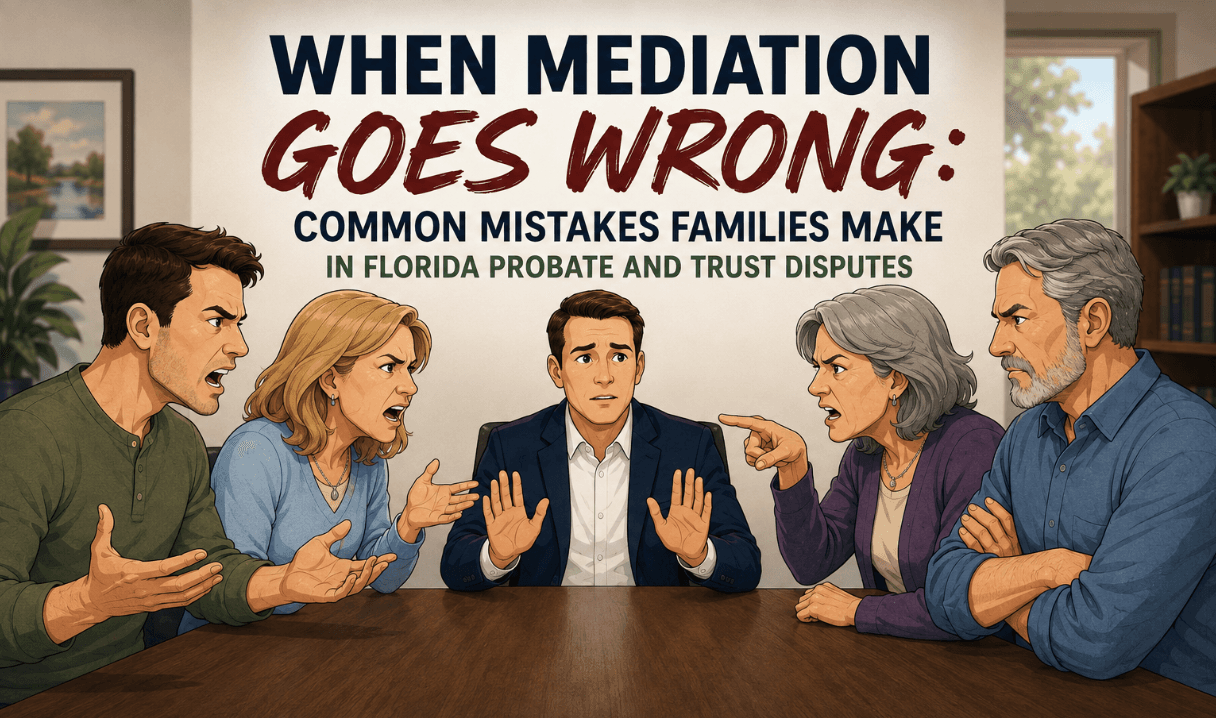
Mediation can be one of the most effective ways to resolve probate and trust disputes without the cost and stress of a full courtroom battle — but only when families go in prepared. Too often, well-meaning people walk into mediation sessions making assumptions that end up costing them time, money, and family relationships. Here are a few scenarios that illustrate what can go wrong, and what you can do to protect yourself.
Scenario One: Signing Without Understanding What You're Agreeing To
Picture a family of four adult siblings disputing their late mother's estate in Orange County. After months of tension, the court orders mediation under Florida Statute § 44.102. The session goes long — eight hours — and by late afternoon everyone is exhausted and emotionally wrung out. A settlement agreement is drafted on the spot. One sibling, eager to be done with the whole ordeal, skims the document and signs. Two weeks later, she realizes she agreed to waive her right to contest a real estate transfer that she believed was the entire reason she showed up to mediation in the first place.
This kind of scenario plays out more than you might expect. Florida law treats a signed mediation settlement agreement as a binding contract. Once it's in writing and signed by all parties, it can be extremely difficult — and expensive — to undo. The confidentiality protections built into Florida's mediation statutes mean that what was said during the session generally can't be used later to argue you were misled. Walking away from a long day of negotiation without having your attorney review the final language before you sign is one of the most preventable and most costly mistakes families make.
Scenario Two: Showing Up Without the Right People in the Room
Consider a trust dispute between a corporate trustee and several beneficiaries in Seminole County. The beneficiaries hire an attorney and prepare carefully. But the corporate trustee sends a representative who has no actual authority to agree to a settlement — she can recommend terms, but final approval has to come from a committee that meets only quarterly. The mediation session produces what feels like a breakthrough agreement, everyone shakes hands, and then nothing happens for three months. By the time the committee finally reviews the terms, one of the beneficiaries has retained a new attorney with a more aggressive strategy, and the fragile consensus falls apart entirely.
Under Florida's mediation framework, the rules require that parties or representatives with full authority to settle be present. That sounds straightforward, but 'full authority' is a detail that often gets glossed over in the scheduling process. If the person across the table can't actually say yes and make it stick, you may be spending your mediation session — and your mediation fees — on a conversation that has no legal weight. Confirming decision-making authority before you ever walk into the room is a step that's easy to overlook and hard to recover from.
Scenario Three: Treating Mediation as a Shortcut Instead of a Process
Imagine two brothers who've been co-personal representatives of their father's estate in Osceola County. They've been feuding for nearly a year over the valuation of a family business included in the estate. A mediator is brought in, and the brothers agree to a settlement figure. What neither of them did beforehand was hire an independent business valuator. One brother genuinely believed the business was worth far less than it actually was; the other knew the real numbers but didn't push for a formal appraisal because the lower figure worked in his favor. Six months after the estate closes, the first brother discovers what the business was actually worth and feels — with some justification — that he was disadvantaged in the negotiation.
Mediation is not meant to be a rush job. The whole point of the process is to give parties control over their outcome in a way that court litigation doesn't allow. But that control only works when both sides have accurate, complete information going in. Skipping due diligence steps like appraisals, accountings, or asset inventories because mediation feels more informal than trial is a mistake that can leave lasting financial and relational damage. Preparation isn't just for courtrooms.
What's Actually Protected — and What Isn't — About Mediation Confidentiality
One thing that surprises many families is how broadly Florida law protects what's said in mediation. Under Florida Statute § 44.405, mediation communications are generally confidential and inadmissible in court proceedings. That protection exists for good reason — it encourages candid conversations that can lead to real resolution. But families sometimes misunderstand confidentiality to mean that mediation is consequence-free, like a practice round before the real game.
It isn't. Once a settlement agreement is signed, it carries the full weight of a contract. The confidentiality rules don't protect you from the agreement itself — only from having negotiation statements used against you later. This distinction matters enormously. Some families hold back information during mediation thinking they can renegotiate after, or share things freely assuming nothing can follow them out the door. Understanding exactly what confidentiality covers — and what it doesn't — before you sit down at the table is essential.
How Working with a Certified Mediator Can Make a Difference
Not everyone who calls themselves a mediator in Florida is certified at the circuit court level. Florida Supreme Court certification as a circuit civil mediator requires specific training, experience, and ongoing education — and it matters in probate and trust cases, which can involve complex financial, family, and legal dynamics all at once. A certified mediator isn't there to take sides or give legal advice, but their experience in structuring conversations, managing emotion, and identifying workable solutions can meaningfully shape whether a session results in genuine resolution or a wasted day.
David A. Yergey, Jr. and David A. Yergey, III of Yergey & Yergey, P.A. hold Florida Supreme Court certifications as a circuit civil mediators and has deep familiarity with the probate and trust issues that so often bring families to the table in the first place. That combination — understanding both the legal landscape and the mediation process — can help parties work through disputes more clearly and with a better grasp of what they're agreeing to.
Five Practical Steps to Protect Yourself in Mediation
First, bring your attorney with you. Mediation is confidential, but that doesn't mean you should go it alone. Having an attorney present means you have someone reviewing the final agreement before you sign — not after. Second, confirm that everyone at the table has actual authority to settle. Ask the question directly before the session begins. Third, do your homework on the assets in dispute. Whether that means getting a real property appraisal, an independent business valuation, or a full estate accounting, go in with accurate numbers. A mediated agreement built on incomplete information may feel like a resolution without actually being one.
Fourth, understand what confidentiality does and doesn't protect. Mediation communications generally stay in the room, but a signed agreement does not. Read every word before you sign, and don't let fatigue or pressure shortcut that step. Fifth, take the time you need. Mediation is not court — there is no judge waiting for a verdict. If the session runs long and you need a break to review a proposed term or confer privately with your attorney, you are entitled to that. The goal is a resolution that actually holds, not just one that ends the day.
Mediation, done well, can be one of the most constructive ways for families to navigate difficult probate and trust disputes — preserving relationships and resources that litigation can consume. Done poorly, it can create new problems on top of existing ones. If you have questions about how the mediation process works in Florida, or whether it might be the right path for your family's situation, the attorneys at Yergey & Yergey, P.A. are glad to have that conversation with you.
This article is intended as a general overview and does not address every fact pattern or recent change in Florida law. Florida statutes are amended regularly; consult a Florida-licensed attorney for guidance specific to your matter.
.png&w=828&q=75&dpl=dpl_CyRWwL6SpTbpzt5n21w4FqR33xt9)
.jpg&w=828&q=75&dpl=dpl_CyRWwL6SpTbpzt5n21w4FqR33xt9)