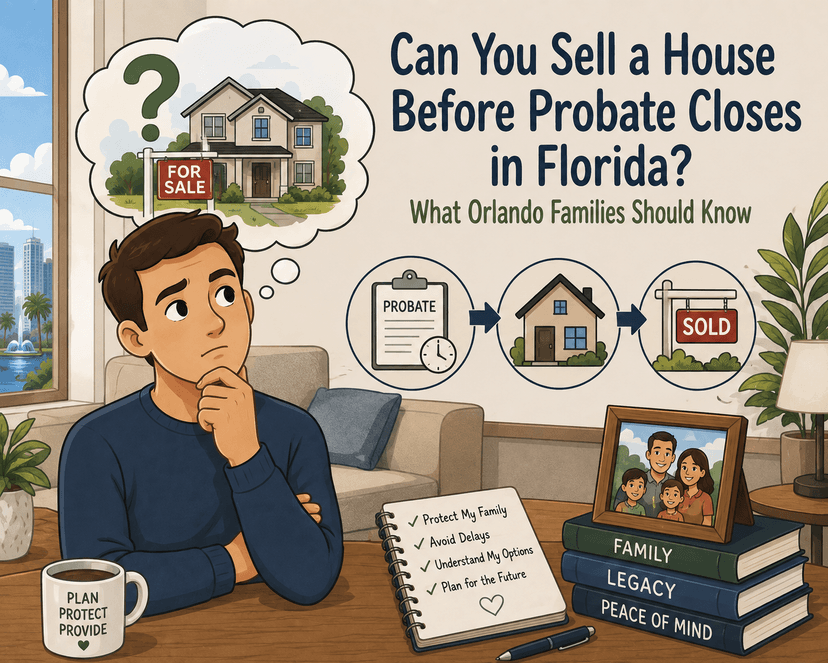
When most people picture probate, they imagine a long, formal process that drags on for the better part of a year. For many Central Florida estates that picture is accurate. But Florida law also provides a shorter, lighter path for smaller estates, and a lot of Orange County families qualify for it without realizing they do.
It is called summary administration, and it is designed to move a modest estate through the court with far less time and expense than the full process. This post explains what a summary administration small estate looks like in Florida, when an estate qualifies, how Orange County handles it, and how it differs from the formal administration most people fear.
What summary administration is
Summary administration is a streamlined probate procedure created by Chapter 735 of the Florida Statutes, with the core rules at section 735.201 and the surrounding sections. Instead of appointing a personal representative who serves for months under court supervision, summary administration lets the court enter an order distributing the estate's assets directly to the people entitled to them.
There are no Letters of Administration, no lengthy creditor administration in the same form as formal probate, and far fewer ongoing filings. For the right estate, it can be the difference between a process that takes many months and one that resolves in a fraction of that time. It is, in short, the small-estate shortcut.
When an estate qualifies
An estate can reach summary administration in one of two ways. The first is by size. Florida law allows summary administration when the value of the probate estate subject to administration falls under a statutory dollar threshold. That threshold is set by the Legislature and has been adjusted, so do not rely on a specific number you read online. Under current Florida law the figure is what the statute currently says, and because thresholds are adjusted periodically, confirm the current figure with counsel before assuming an estate qualifies.
The second path has nothing to do with size. If the person has been dead for more than two years, the estate may proceed by summary administration regardless of its value. The reasoning is that after two years the period for most creditor claims has run, so the streamlined process becomes available even for larger estates that would otherwise require formal administration.
How the two-year path works
The two-years-after-death path is one of the most useful and least understood features of Florida probate. Families sometimes discover, long after a parent's death, that a house or account was never properly transferred. If more than two years have passed, they are often relieved to learn that the heavy formal process may not be required.
This matters in Orange County because old, unprobated assets are common. A homestead in a longtime Orlando neighborhood may sit untransferred for years until someone tries to sell it. When that happens, the two-year rule frequently opens the door to summary administration, even when the property's value would have demanded formal administration if the person had died recently.
How Orange County handles it
A summary administration in Orange County is filed with the Clerk of the Circuit Court, Probate Division, in Orlando, the same division that handles formal estates, within the Ninth Judicial Circuit. The process centers on a petition for summary administration that is signed or verified by the interested parties and sets out the estate's assets, its value, and the people entitled to receive the property.
The petition must be precise. It identifies the heirs or beneficiaries, addresses known creditors, and deals with homestead if the estate includes a home. When the court is satisfied, it enters an order of summary administration that directs each asset to the proper recipient. Because there is no personal representative to clean up loose ends afterward, getting the petition right the first time matters even more than in formal administration.
A Pine Hills example
Imagine a hypothetical family in Pine Hills here in Orange County. Their mother, Gloria, died several years ago leaving a small bank account and a modest home. At the time, the family was grieving and never opened probate. Now they want to sell the house, and the title company tells them they cannot, because the home is still in Gloria's name.
Because more than two years have passed since Gloria's death, her estate likely qualifies for summary administration through the two-year path, regardless of the home's value. The family files a petition for summary administration in the Orange County Probate Division, the court reviews who is entitled to the property, and an order of summary administration transfers the home to the heirs so it can finally be sold. What felt like a dead end becomes a manageable filing. This is hypothetical, but it is one of the most common reasons families discover summary administration at all.
How it differs from formal administration
The clearest difference is supervision. Formal administration appoints a personal representative who receives Letters of Administration, marshals assets, handles creditors over a defined period, and answers to the court throughout. Summary administration skips the personal representative entirely and asks the court to distribute the assets directly.
That makes summary administration faster and usually cheaper, but it is not always available or advisable. If an estate has significant unknown creditors, ongoing business affairs, or disputes among the heirs, formal administration may be the safer route even when the numbers technically allow summary administration. Choosing between the two is a judgment call, not just a math problem, which is why the decision deserves a conversation rather than a quick assumption.
Practical next steps
If you think an Orange County estate might qualify for summary administration, start by getting a realistic value of the probate assets and noting how long ago the person died. Those two facts, value and timing, determine which path is even available.
Then gather the names of the heirs or beneficiaries and a list of any known debts, and identify whether the estate includes a homestead. With that in hand, an attorney can quickly tell you whether summary administration fits or whether formal administration is the wiser choice for the situation.
How our firm helps
At Yergey & Yergey, P.A., we evaluate Orange County estates to determine whether summary administration is the right tool, prepare the petition correctly, and handle the homestead and creditor questions that trip families up. When the two-year path applies to an old, unprobated Orlando property, we know how to use it. When formal administration is the safer choice, we tell you that too.
We encourage clients to bring in what they found online so we can explain what is right, what is wrong, and what the tradeoffs are. A conversation with a lawyer is better than guessing based on internet content, online forms, or AI-generated answers.
If you have a smaller estate or an old unprobated asset in Orange County, call our office at (407) 843-0430 or visit orlandoprobatelawyer.com to schedule a consultation. We have been helping Orlando families since 1928 — and we would be glad to help yours.
Frequently asked questions
What makes an estate eligible for summary administration?
There are two paths. One is value: the estate qualifies if the probate assets subject to administration fall under a statutory dollar threshold. The other is time: if the person died more than two years ago, the estate may use summary administration regardless of value.
What is the current dollar threshold for summary administration?
It is set by the Florida Legislature and has been adjusted over time, so a specific figure you find online may be outdated. Under current Florida law the threshold is whatever the statute currently provides. Thresholds are adjusted periodically, so confirm the current figure with counsel.
How is summary administration different from formal administration?
Formal administration appoints a personal representative who serves under court supervision for months. Summary administration skips that step and has the court distribute assets directly. It is faster and usually less expensive, but it is not right for every estate.
Can I use summary administration for a house that was never probated years ago?
Often yes. If more than two years have passed since the owner's death, the two-year path may allow summary administration regardless of the home's value, which is a common solution for an old, untransferred Orlando property.
Do I need a lawyer for summary administration?
It is not always legally required, but the petition has to be exact because there is no personal representative to fix mistakes later. Many families use counsel to handle the homestead, creditor, and heirship questions correctly the first time.
This article is intended as a general overview and does not address every fact pattern or recent change in Florida law. Florida statutes are amended regularly; consult a Florida-licensed attorney for guidance specific to your matter.