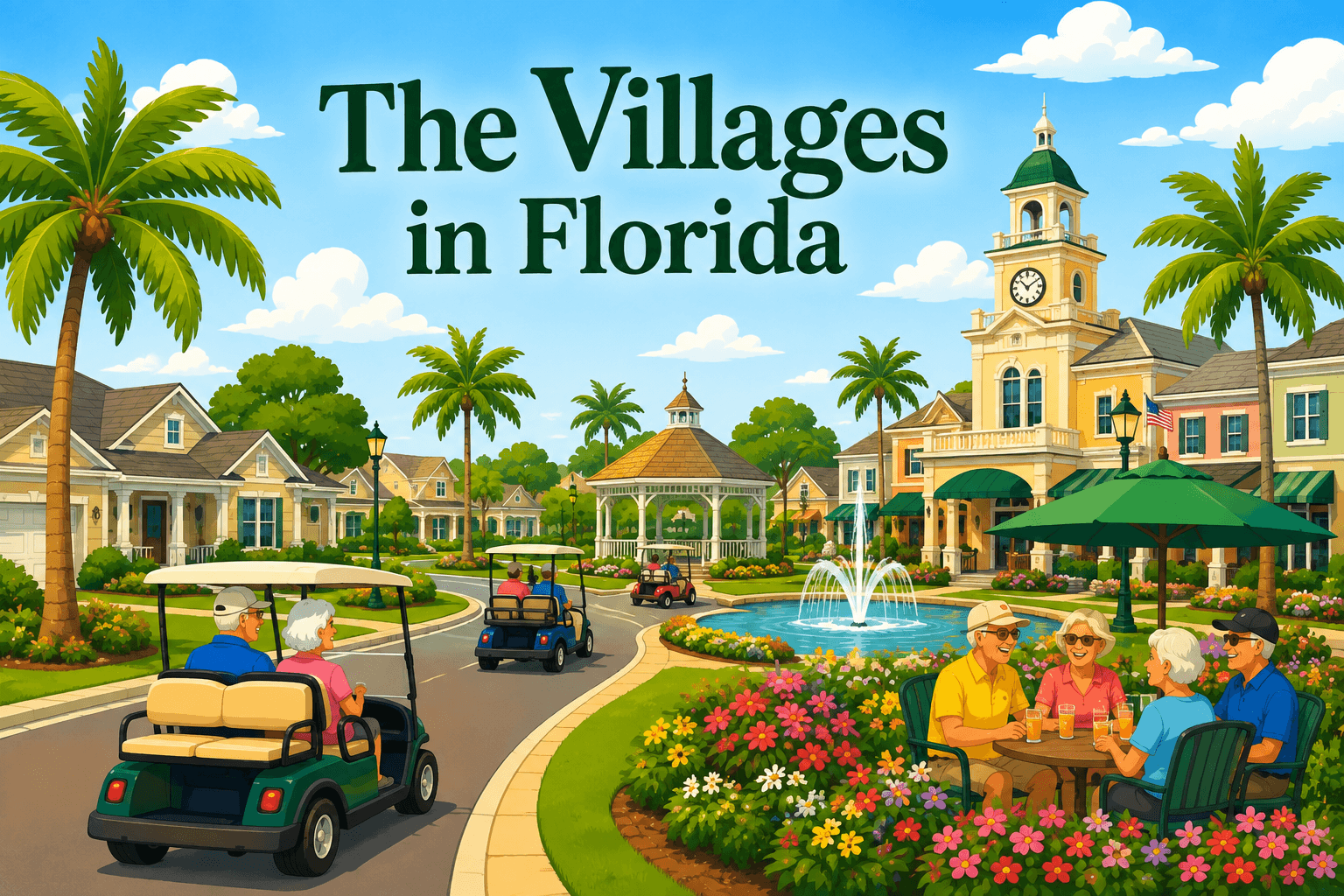
The Villages is a remarkable place to retire, and a genuinely unusual one for estate planning. The community does not sit in a single county. It spreads across Sumter, Lake, and Marion, and the county line can run right through a neighborhood. Two friends who play cards together every week, living a few minutes apart, may technically reside in different counties.
That matters more than most residents realize. The county your home sits in is the county whose probate court your estate will most likely use one day. For a community drawn from all over the country, with old wills and trusts signed in other states, getting the Florida details right is worth a careful look.
Three counties, three different courthouses
The Villages straddles county lines, and each county sits in a different judicial circuit. Sumter and Lake counties are both part of the Fifth Judicial Circuit, while Marion County is also in the Fifth Judicial Circuit — but the courthouses and clerks' offices are in different cities, and the case is filed in the county of domicile.
In practical terms, a Villages resident's estate will be administered in the county where their home is located. A home on the Sumter County side leads to a Sumter County filing; a home on the Lake County side leads to a filing handled through Lake County, whose courthouse is in Tavares; and a home on the Marion County side leads to a Marion County filing. Same community, different venues, depending on which side of an invisible line your front door is on.
How domicile and venue decide your probate court
Florida sets probate venue by the decedent's county of domicile under Section 733.101. Domicile is your true, fixed, permanent home — and for most full-time Villages residents, that is clear: it is the home where they live, claim homestead, register to vote, and hold a Florida driver's license.
The complication is not usually which county within The Villages — your address answers that. The real issue is whether a resident has fully established Florida domicile at all. Many Villages residents kept a house up north, still have an old will and trust from their prior state, and split time between the two. If a person has not clearly made Florida their domicile, the question of where the estate is administered — and which state's law governs — can become contested. Establishing Florida domicile cleanly, in writing and in fact, is one of the most valuable things a Villages resident can do.
Out-of-state wills and trusts
A great many Villages residents arrive with an estate plan drafted somewhere else — Ohio, Michigan, New York, Illinois. A will or trust validly signed in another state is often still valid in Florida, but valid is not the same as optimal.
Florida has its own homestead rules, its own durable power of attorney statute, its own health care surrogate forms, and its own self-proving affidavit procedure that speeds probate here. An out-of-state will may lack the Florida self-proving affidavit, which can add steps. An old durable power of attorney may not meet Florida's current requirements. And a trust funded with out-of-state assets may need attention as the family's life shifts to Florida. Bringing the plan in for a Florida review, rather than assuming it transfers seamlessly, prevents avoidable friction later.
A Villages scenario
Consider a hypothetical. A couple moved to The Villages from Indiana and bought a home that, unbeknownst to them, sits on the Lake County side of a neighborhood that is mostly in Sumter County. They kept their Indiana will and trust, registered to vote in Florida, and got Florida licenses, but they never updated their documents.
When the husband passed, the family assumed everything would be handled in Sumter County, because that is the county most associated with The Villages. In fact, because the home was on the Lake County side, the matter belonged in Lake County, filed through the courthouse in Tavares. The Indiana trust was still valid, but it had never been retitled to reflect their Florida homestead, so the home was not actually held the way the couple believed. A short Florida review years earlier would have caught both issues.
The lesson is not that anything went wrong on purpose. It is that an unusual geography plus out-of-state documents creates exactly the kind of gap worth closing in advance.
Common mistakes and misconceptions
The first misconception is that The Villages is one place for legal purposes. It is not; it spans three counties, and your specific address controls. The second is assuming an out-of-state will or trust needs no Florida attention. It usually benefits from at least a review. The third is failing to firmly establish Florida domicile while keeping strong ties to another state, which can invite a dispute over which state — and which county — controls.
A subtler mistake is creating a trust but never funding it. A revocable trust only avoids probate for the assets actually titled in its name. A home still deeded to the individuals, not the trust, can end up in probate despite the family's intentions.
Practical next steps
Confirm which county your home actually sits in; the property records or your tax bill will tell you. Establish Florida domicile clearly through your driver's license, voter registration, homestead exemption, and a declaration of domicile if appropriate. Then have any out-of-state will, trust, power of attorney, and health care documents reviewed under Florida law.
If you have a revocable trust, verify that your home and major accounts are actually titled in the trust's name. Coordinating across county lines is straightforward once the documents and the domicile are aligned.
How our firm helps
We help Villages residents make sense of the county-line puzzle and bring their out-of-state plans into line with Florida law. We confirm which court a plan would land in, shore up Florida domicile, and make sure a trust is actually funded so it does what the family intended.
We encourage clients to bring in what they found online so we can explain what is right, what is wrong, and what the tradeoffs are. A conversation with a lawyer is better than guessing based on internet content, online forms, or AI-generated answers.
Whether your Villages home sits in Sumter, Lake, or Marion County, call our office at (407) 843-0430 or visit orlandoprobatelawyer.com to schedule a consultation. We have been helping Orlando families since 1928 — and we would be glad to help yours.
Frequently asked questions
Does it matter which county of The Villages I live in? Yes. The Villages spans Sumter, Lake, and Marion counties, and your address determines which county's probate court would administer your estate.
Is my out-of-state will still valid now that I live in The Villages? Often yes, but it may lack Florida features like a self-proving affidavit, and your power of attorney and health care documents may not meet Florida standards. A Florida review is worthwhile.
How do I make sure my estate is handled in Florida and not my old state? Establish Florida domicile clearly — driver's license, voter registration, homestead exemption, and, when appropriate, a declaration of domicile — and update your documents to Florida.
I have a trust from up north. Is that enough? Only if it is properly funded with your Florida assets. A trust that does not hold your Villages home will not keep that home out of probate.
Which courthouse would my estate use? It depends on your county. A Lake County home is handled through Tavares; Sumter and Marion homes are filed in their respective county courthouses. We can confirm based on your address.
This article is intended as a general overview and does not address every fact pattern or recent change in Florida law. Florida statutes are amended regularly; consult a Florida-licensed attorney for guidance specific to your matter.