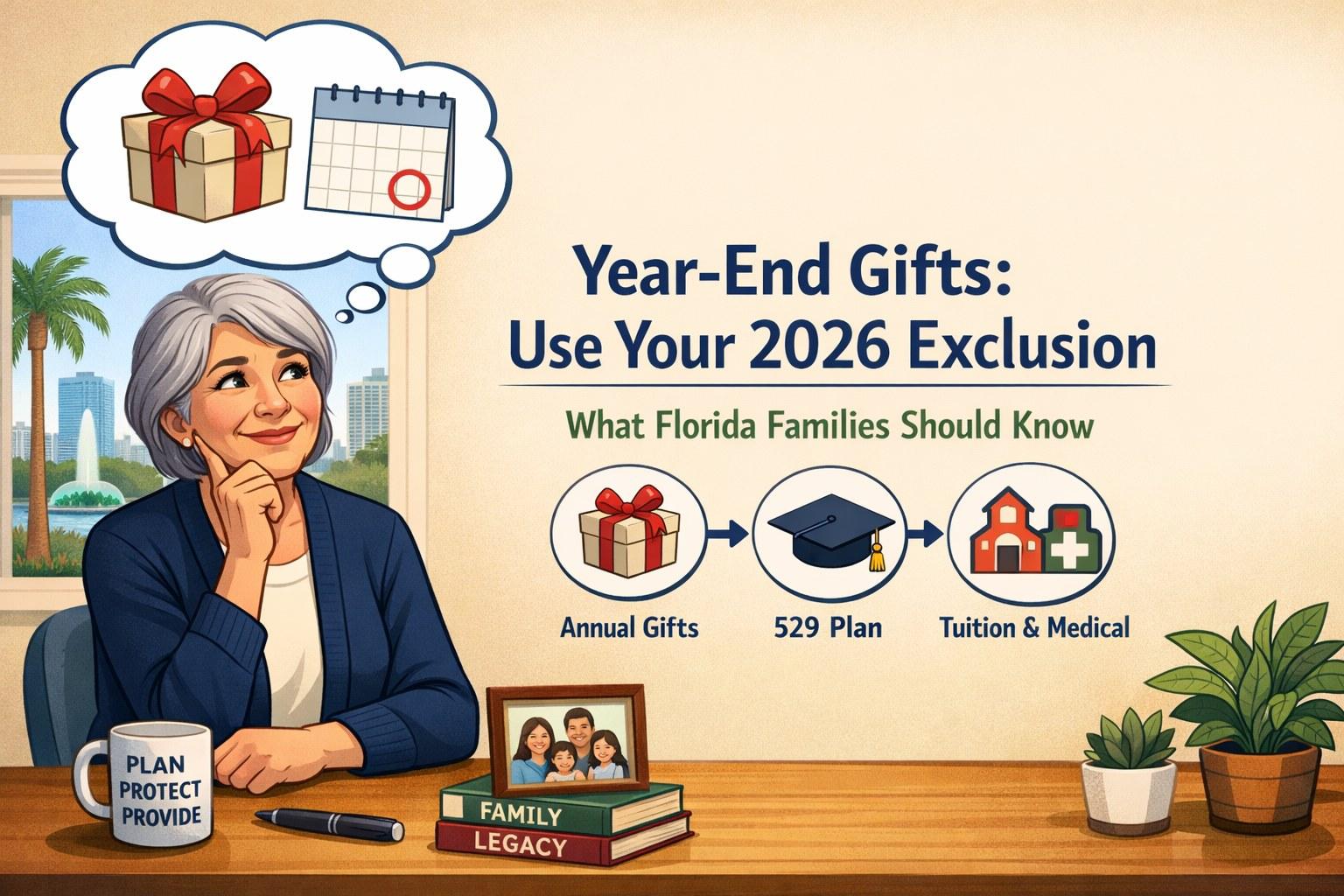
For 2026, you can give up to $19,000 to as many people as you like without using any of your lifetime exemption. You can also pay someone's tuition or medical bills directly, in any amount, without it counting as a gift. The annual gift tax exclusion for 2026 does not carry over, so any part you leave unused on December 31 is gone. A fresh exclusion starts January 1, and the IRS has announced it rises to $20,000 for 2027.
Florida does not impose its own gift tax, so federal law sets all of the rules.
The key figures:
- Annual exclusion, per recipient (26 U.S.C. § 2503(b)) — 2026: $19,000; 2027: $20,000
- Married couple who split gifts (§ 2513) — 2026: $38,000; 2027: $40,000
- 529 five-year election, per beneficiary (§ 529(c)(2)(B)) — 2026: $95,000; 2027: $100,000
- Tuition and medical paid directly (§ 2503(e)) — 2026: No limit; 2027: No limit
- Lifetime basic exclusion, gift and estate (§ 2010(c)(3)) — 2026: $15,000,000; 2027: $15,480,000
The 2026 amounts come from Rev. Proc. 2025-32; the 2027 amounts from the IRS's November 5, 2026 announcement (IR-2026-133).
Annual gift tax exclusion 2026: how it works
The exclusion is counted per giver, per recipient, per calendar year. You can give $19,000 to each child, each child's spouse and each grandchild without reporting any of it.
Going over $19,000 to one person usually does not mean you owe tax. You must file a federal gift tax return, Form 709 (26 U.S.C. § 6019), and the amount over the exclusion is applied against your lifetime basic exclusion. Under the 2025 federal tax law (Pub. L. 119-21), that basic exclusion is $15,000,000 for 2026, it is shared between the gift tax and the estate tax, and inflation indexing raises it to $15,480,000 for 2027. The law has no scheduled expiration date, though Congress can always change it. See our page on the federal estate tax.
Two limits are worth knowing:
- Present interests only. The exclusion does not apply to "gifts of future interests in property" (26 U.S.C. § 2503(b)). Gifts to a trust often fall in that category, so annual gifts to an irrevocable trust need careful drafting.
- Grandchildren. Outright annual-exclusion gifts and direct tuition or medical payments for a grandchild generally do not use any of your generation-skipping transfer tax exemption (26 U.S.C. §§ 2611(b)(1), 2642(c)). Gifts in trust for a grandchild must meet extra conditions. See our page on generation-skipping trusts.
Married couples: doubling the exclusion
If each spouse gives $19,000 from his or her own funds, a couple can give $38,000 to each recipient with no return. If the money comes from one spouse, the couple can elect "gift splitting" under 26 U.S.C. § 2513, which treats each gift as made half by each spouse. A few rules apply:
- Both spouses must be U.S. citizens or residents at the time of the gift.
- The election covers all gifts either spouse made to third parties that year.
- A Form 709 must be filed to split gifts, whatever the amount.
- Once you split, each spouse is jointly and severally liable for any gift tax for that year.
Front-loading a 529 plan
A contribution to a 529 college savings plan counts as a completed gift of a present interest to the beneficiary, so it qualifies for the annual exclusion. If you contribute more than the annual exclusion in one year, you can elect to treat the contribution as made evenly over five years (26 U.S.C. § 529(c)(2)(B)).
With the 2026 exclusion at $19,000, that means one person can put up to $95,000 into a grandchild's 529 plan this year and use no lifetime exemption. A married couple who split gifts can each make the election, for up to $190,000 per beneficiary. You make the election on a Form 709 for 2026 by checking the box on line B of Schedule A and attaching a short statement.
The trade-offs:
- You use up five years of exclusion at once. A full $95,000 contribution is treated as a $19,000 gift to that beneficiary in each year from 2026 through 2030. It is figured on the 2026 exclusion, so the 2027 increase does not enlarge a 2026 election.
- Dying during the five years. If you die before the five-year period ends, the portion allocated to the years after your death is pulled back into your taxable estate (26 U.S.C. § 529(c)(4)(C)).
- A 529 contribution is not a tuition payment. It does not qualify for the unlimited tuition exclusion discussed below.
529 plans are also more flexible now. Starting in 2026, up to $20,000 a year can cover elementary and secondary school costs, including books, curriculum materials and certain tutoring, not just tuition. After an account has been open 15 years, up to $35,000 over the beneficiary's lifetime can be rolled into the beneficiary's Roth IRA, subject to annual and other limits.
Paying tuition and medical bills directly
Tuition paid directly to a school, or medical bills paid directly to a provider, for someone else are not gifts at all for gift tax purposes (26 U.S.C. § 2503(e)). There is no dollar limit, the person need not be a relative, and these payments come on top of the $19,000 annual exclusion.
The rules are strict:
- Tuition only, paid to the school. The payment must go directly to a qualifying school (one with a regular faculty, curriculum and enrolled student body). Books, supplies, dorm fees and room and board do not qualify (Treas. Reg. § 25.2503-6(b)(2)). Money given to a trust to pay tuition later does not qualify either.
- Medical care, paid to the provider. This covers care that meets the income tax definition of medical care, and it also covers health insurance premiums paid for someone. Reimbursing a family member after he or she pays the bill does not qualify, and payments later reimbursed by the person's own insurance do not qualify to that extent (Treas. Reg. § 25.2503-6(b)(3)).
These payments do not by themselves require a gift tax return.
Getting the timing right before December 31
A gift counts in the year it is complete, which is when you have given up control of it (Treas. Reg. § 25.2511-2(b)). That matters most for checks. Under Rev. Rul. 96-56, a check to a family member counts as a 2026 gift only if it is deposited, cashed or presented for payment in 2026, and your bank pays it when first presented, while you are alive. A check handed over on December 30 but deposited on January 4 is a 2027 gift. It uses your 2027 exclusion for that person, and any 2026 exclusion you did not otherwise use for them is gone.
Done right, the calendar works in your favor: $19,000 completed by December 31 and another $20,000 in January moves $39,000 to one person within weeks, with no return required.
Write checks early and ask recipients to deposit them promptly, or use a wire. Start stock transfers well before the last week of December, and keep a record of each gift.
If you do need to file Form 709 for 2026 gifts, it is due April 15, 2027 (26 U.S.C. § 6075(b)). An extension of your income tax return also extends the gift tax return, or you can file Form 8892.
What to give: cash or appreciated assets?
When you give property, the recipient generally takes your tax basis (26 U.S.C. § 1015). When someone inherits property from you, the basis is generally reset to its value at the date of death (26 U.S.C. § 1014).
Give away stock bought decades ago for very little, and the recipient takes on your built-in gain; keep it until death, and that gain may never be taxed. With a $15 million exemption, many families will owe no estate tax, and for them basis often matters more, which makes cash or assets that have not grown much the better lifetime gifts. For larger estates, moving future growth out of the estate may still be worth it.
Frequently asked questions
Do I have to report gifts to my spouse? Generally not, if your spouse is a U.S. citizen, because gifts between spouses qualify for an unlimited marital deduction (26 U.S.C. § 2523(a)). If your spouse is not a U.S. citizen, the exclusion for gifts to your spouse is $194,000 for 2026 and $201,000 for 2027.
Does the person receiving a gift owe tax on it? No federal income tax is owed on the gift itself (26 U.S.C. § 102(a)). Any federal gift tax is the giver's responsibility (26 U.S.C. § 2502(c)).
Does Florida have a gift tax or an estate tax? No. Florida does not impose its own gift tax, and Florida's estate tax does not apply to people who died after December 31, 2004.
How we can help
Year-end gifts work best as part of an overall estate plan. Yergey & Yergey, P.A. was founded in 1928, and David A. Yergey III holds an LL.M. in Taxation. We can review your gifting goals, coordinate them with your will or trust, and prepare any gift tax return you need. Consultations are available at our Orlando office on Fern Creek Avenue, by phone, or by video. This post is general information, not advice for your situation.
IRS Circular 230 Disclosure: To ensure compliance with requirements imposed by the IRS, any U.S. federal tax advice contained in this communication is not intended or written to be used, and cannot be used, for the purpose of (i) avoiding penalties under the Internal Revenue Code, or (ii) promoting, marketing, or recommending to another party any transaction or matter addressed herein.