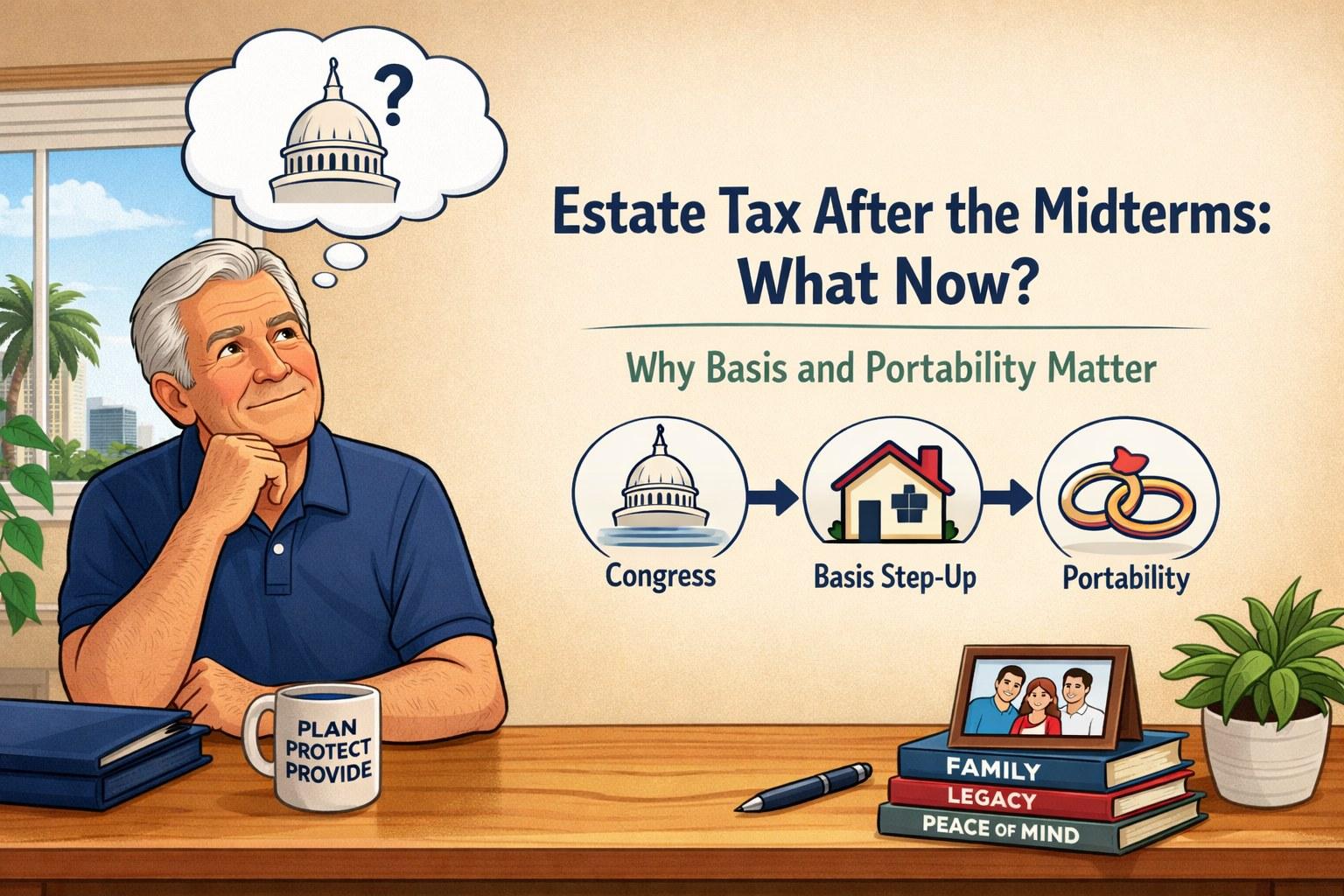
How will the estate tax after the 2026 midterms differ from today? For most families, very little. Democrats won control of both the House and the Senate on November 3, 2026, according to projections by CBS News and NBC News, but President Trump still holds the veto, and in our view a major rewrite of the estate tax is unlikely over the next two years. That shifts the useful planning questions away from the size of the exemption and toward two things that affect far more families: income tax basis and the portability election for surviving spouses.
Estate tax after the 2026 midterms: what changed and what did not
The new Congress takes office in January 2027. Under the Constitution, congressional terms end at noon on January 3 (U.S. Const. amend. XX, § 1). A bill the President vetoes becomes law only if two-thirds of each chamber votes to override it (U.S. Const. art. I, § 7). The projected Democratic majorities fall well short of two-thirds of either chamber.
The likely result is divided government. A tax bill that raises or lowers rates needs a Congress that will pass it and a President who will sign it, and we do not expect either side to have both before 2029. That is a forecast, not a certainty, and laws can change. But it is not a reason to rush into, or delay, a plan you would otherwise put in place.
Where the federal estate tax stands today
The 2025 tax law (Pub. L. 119-21, signed July 4, 2025) set the basic exclusion amount at $15,000,000 per person for 2026 (26 U.S.C. § 2010(c)(3)). Starting in 2027, that amount is adjusted each year for inflation; the IRS has announced that the figure for deaths in 2027 is $15,480,000. The same law removed the provision that would have cut the exemption roughly in half after 2025, so there is no scheduled drop in the current statute. Above the exemption, the top federal estate tax rate is 40 percent (26 U.S.C. § 2001(c)).
Florida adds nothing on top. Florida's Department of Revenue confirms that a federal change eliminated Florida's estate tax for people who died after December 31, 2004, and the Florida Constitution bars a state estate or inheritance tax beyond what can be credited against a federal tax (Fla. Const. art. VII, § 5(a)). Our Florida estate tax planning page covers the techniques for estates near or above the federal exemption.
With proper planning, a married couple can pass up to $30 million free of federal estate tax, so most Central Florida families will never owe it. For them, the bigger tax is usually the capital gains tax their children may pay when they sell property.
Why income tax basis now matters more
"Basis" is, roughly, what you paid for an asset, and capital gains tax is figured on the difference between the sale price and the basis. Federal law treats inherited and gifted property very differently.
- Property inherited at death generally takes a basis equal to its fair market value on the date of death (26 U.S.C. § 1014(a)(1)). This is the "step-up." The gain that built up during the owner's lifetime generally escapes income tax.
- Property received as a lifetime gift generally keeps the giver's basis (26 U.S.C. § 1015(a)). The built-in gain carries over to the person who received it.
A simple illustration. Suppose a parent bought stock for $200,000 and it is now worth $1,000,000. If the parent gives the stock to a child during life and the child sells it for $1,000,000, the child reports an $800,000 gain. If the child instead inherits the stock at the parent's death, when it is worth $1,000,000, the child's basis is $1,000,000 and a sale at that price produces no gain.
When the exemption was lower, many families gave assets away during life to shrink a taxable estate and accepted the carryover basis as the price. For an estate that will never owe estate tax, that trade often no longer makes sense, and holding appreciated assets until death can save the next generation real income tax. Lifetime gifts still have a place, such as helping a child now or shifting future growth out of a very large estate, but they deserve a closer look at what they cost in basis.
Two limits apply. Traditional IRAs do not get a step-up; beneficiaries generally pay income tax on withdrawals (26 U.S.C. §§ 408(d)(1), 1014(c)). And appreciated property you give to someone who dies within one year, and that comes back to you or your spouse, keeps the decedent's old basis (26 U.S.C. § 1014(e)).
A note for married couples on a "double" step-up
In community property states, both halves of a couple's community property can receive a new basis when the first spouse dies (26 U.S.C. § 1014(b)(6)). Florida is not a community property state, but since 2021 Florida law has allowed married couples to create a Florida community property trust, and the statute provides that such a trust is treated as established under Florida's community property laws for purposes of § 1014(b)(6) (Fla. Stat. §§ 736.1501–736.1512, § 736.1511). The IRS has not issued guidance confirming that it will respect this treatment for a Florida trust, and these trusts carry real consequences for divorce and each spouse's rights, so they call for careful, individual advice.
Portability: the surviving spouse's safety net
When the first spouse dies, any exemption that spouse did not use can pass to the surviving spouse. The tax code calls it the deceased spousal unused exclusion, or DSUE, amount (26 U.S.C. § 2010(c)(2)(B), (c)(4)). The catch is that it is not automatic. The executor must file a federal estate tax return (Form 706) that computes the amount and elects portability, and the return must be filed on time, even if no tax is due (26 U.S.C. § 2010(c)(5)(A)). The return is generally due nine months after death, plus any extension.
Portability also works well with basis planning. When assets pass to the surviving spouse and stay in the survivor's estate, they generally receive another new basis at the survivor's death (26 U.S.C. § 1014(a), (b)(9)), while the first spouse's unused exemption, preserved through portability, helps keep that larger estate under the limit.
A few rules to keep in mind:
- The DSUE amount is a fixed dollar figure computed on the first spouse's return. The law indexes the basic exclusion amount for inflation, but not the DSUE amount carried over.
- Portability does not carry over the first spouse's generation-skipping transfer (GST) tax exemption. IRS instructions state that a portability election "does not apply to or impact GST tax exemption."
- A surviving spouse can use only the DSUE amount of the last deceased spouse.
- The IRS can examine the first spouse's estate tax return when it checks the DSUE amount, even after the normal time limit for assessing tax has passed (26 U.S.C. § 2010(c)(5)(B)).
If the return was not filed on time, all may not be lost. For estates that were not otherwise required to file, Rev. Proc. 2022-32 allows a late portability-only return filed on or before the fifth anniversary of the death. Our portability election page explains the deadlines, who can file, and how the election is made.
Reviewing an older bypass trust plan
Many wills and revocable trusts written years ago, when the exemption was much lower, use a "credit shelter" or "bypass" trust. At the first death, a formula moves assets up to the exemption amount into a trust for the surviving spouse that is kept out of the survivor's taxable estate.
That design still has good uses, such as protecting children from a prior marriage or using the first spouse's GST exemption. But assets kept out of the survivor's estate generally do not get a new basis at the survivor's death, and a formula written for a smaller exemption may now move far more into the bypass trust than the family expects. Whether a plan should change depends on the family, the assets, and the document's wording, so this is a review to do with your attorney, not a reason to tear up a plan. If you have a revocable living trust signed before the recent law changes, it is a good time to read it again.
A short checklist for the year ahead
- If your spouse died in the last five years, find out whether a Form 706 was filed to elect portability. If not, ask whether a late election is still available.
- Before making large gifts of appreciated property, compare the estate tax savings, if any, with the capital gains your family may give up.
- Find your basis records for stock, real estate, and business interests, so your family can document the date-of-death values later.
- Read the funding formulas in any will or trust signed when the exemption was lower.
- Check beneficiary designations on retirement accounts and life insurance, which pass outside the will.
How we can help
Yergey & Yergey, P.A. has helped Central Florida families with estate planning and trust administration since 1928. David A. Yergey III holds an LL.M. in Taxation from the University of Alabama, and we offer flat-fee estate planning. If you would like to review whether your plan still fits current tax law, or whether a portability election was filed after a spouse's death, we invite you to schedule a consultation with our Orlando office, in person, by phone, or by video.
IRS Circular 230 Disclosure: To ensure compliance with requirements imposed by the IRS, any U.S. federal tax advice contained in this communication is not intended or written to be used, and cannot be used, for the purpose of (i) avoiding penalties under the Internal Revenue Code, or (ii) promoting, marketing, or recommending to another party any transaction or matter addressed herein.