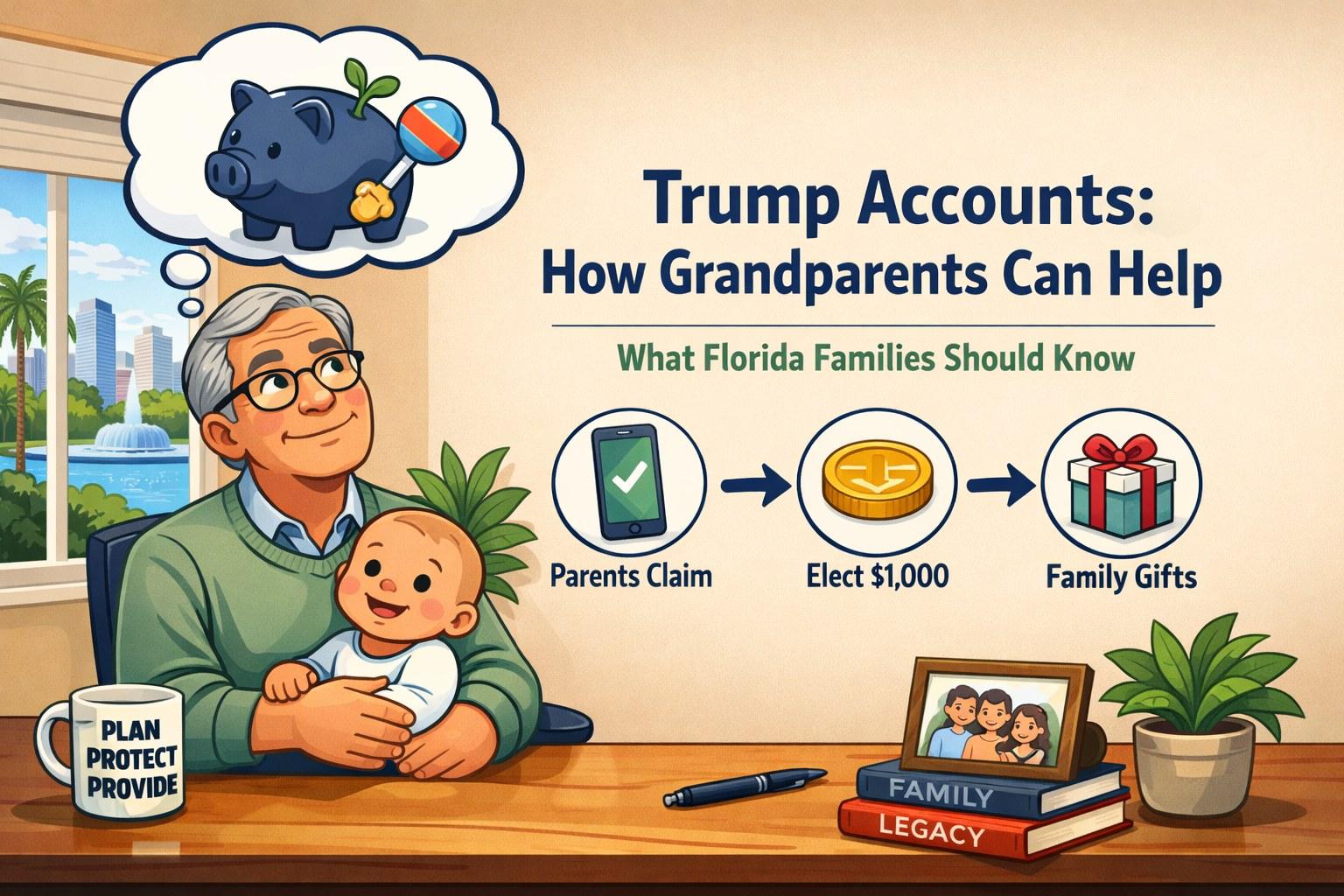
Trump accounts for grandchildren are open to a grandparent's help, but only up to a point. Once a parent has claimed the child's account, a grandparent can add money within a $5,000-per-year limit that the whole family shares. A grandparent generally cannot claim the account, control it, or request the government's one-time $1,000 deposit. Those steps belong to the parents. If the parents die, whoever steps into their legal role manages the account, which a Florida estate plan can settle in advance.
What changed this fall: accounts now open automatically
When we published our overview of Trump accounts in July, a family had to elect to open an account. Under temporary regulations issued September 30, 2026, the Treasury Secretary now makes that election for eligible children (Treas. Reg. § 1.530A-1T(d)(2)), and the IRS reports that automatic enrollment began October 1, 2026. Eligible means under 18 with a Social Security number (26 U.S.C. § 530A(b)(2)).
An automatically opened account is a holding place, not a finished account. Treasury is its "responsible party," and until someone claims it, it can receive only charitable or government "general contributions" and the $1,000 pilot program deposit. It cannot take money from parents, grandparents or employers.
Charitable pledges are already in place. In December 2025, the White House announced that Michael and Susan Dell would add $250 for the first 25 million children age 10 and under living in ZIP codes with median incomes below $150,000.
Trump accounts for grandchildren: what grandparents can do
Contribute, once the account is claimed. Treasury's program site says that once a child's account is claimed, families, friends and employers can contribute, and parents can share a code in the Trump Accounts app so relatives can contribute directly.
Stay within the shared annual limit. Contributions from family, friends and employers together cannot exceed $5,000 per child for a calendar year (26 U.S.C. § 530A(c)(2)). Employer contributions, which can be up to $2,500 tax-free to the employee (26 U.S.C. § 128), count toward that $5,000. Government, charitable and rollover deposits do not. If parents and two sets of grandparents all plan to give, coordinate first. Contributions over the limit must be taken back out, and the earnings on the excess are subject to an additional tax equal to 100% of those earnings (26 U.S.C. § 530A(d)(5)).
Expect no deduction. Contributions made before the year the child turns 18 are not deductible (26 U.S.C. § 530A(c)(1)). Under the IRS instructions, money from family members becomes after-tax "basis" in the account, which affects how withdrawals are taxed later.
Understand what happens at 18. No withdrawals are allowed before the year the child turns 18 (26 U.S.C. § 530A(d)(1)), and once the child turns 18, the grandchild controls the account. The grandparent has no say in how the money is used.
What a grandparent usually cannot do is claim the account. The regulations allow a claim only by "a guardian or legal custodian having authority under applicable law to manage the account beneficiary's property or financial affairs," or by the child once he or she has legal capacity (Treas. Reg. § 1.530A-1T(f)(1)). A grandparent without legal authority over the child's property does not fit.
What only the parents can do: claim the account and elect the $1,000
Parents have two separate jobs.
- Claim the account. According to the IRS, the parent uses the Trump Accounts app or website, verifies his or her identity and authority to manage the account, and then claims and activates it. Activation includes signing the account agreement. The person who claims and activates the account becomes its responsible party.
- Elect the $1,000. The IRS says parents must elect the $1,000 pilot contribution even if Treasury opened the account automatically. The election is made on Form 4547, which can be submitted through the Trump Accounts app, the Trump Accounts website or the parent's IRS Individual Online Account. The child must be a U.S. citizen born from January 1, 2025, through December 31, 2028, with a Social Security number, and only one election is allowed per child (26 U.S.C. § 6434). Treasury adds that the account must also be claimed to receive it.
The $1,000 election belongs to the person who expects the child to be his or her "qualifying child" for tax purposes that year, which normally means a parent. A grandchild can be a grandparent's qualifying child, but only if the other tests are met, including living with the grandparent for more than half the year (26 U.S.C. § 152(c)). So a grandparent raising a grandchild may be the right person to make the election. Otherwise, the most useful thing a grandparent can do is remind the parents to complete both steps.
Who manages a Trump account if the parents die
The child owns the account; the responsible party acts only on the child's behalf and has no ownership interest. So the real question is not who inherits it but who manages it until the child turns 18.
The regulations leave succession to the account's governing instrument and applicable law. The trust agreement used by Treasury's initial trustee provides:
- A living responsible party can resign or hand the role to a successor, who must complete verification.
- If the responsible party dies or becomes incapacitated, the trustee will replace that person with someone who petitions for the role, such as a legal guardian of the child. The trustee may ask for documents such as a death certificate. A legal guardian does not need a court order, but if several people with equal standing compete, the trustee may require one.
- Until a successor is in place, the account is placed in a restricted status. It can still receive certain government and charitable deposits, but no one can direct its investments.
If the account was never claimed, the regulations again point to a guardian with legal authority over the child's property. Either way, the answer runs through a legal guardian.
Florida estate planning steps that answer the question
If one parent dies, Florida law makes the surviving parent the child's sole natural guardian (Fla. Stat. § 744.301(1)). The harder case is when both parents are gone. Then a court appoints a guardian on petition, and a guardian of a minor, whether of the person or of the property, has the authority of a plenary guardian (Fla. Stat. § 744.3021).
Parents can shape that choice in two ways:
- Name a guardian in your will. The court must consider anyone designated as guardian in a will in which the child is a beneficiary (Fla. Stat. § 744.312(3)(c)). See our page on wills in Florida.
- Sign a preneed guardian declaration. Both parents, or a surviving parent, may name a preneed guardian of the person, the property or both, plus an alternate. The declaration must be signed before two witnesses and filed with the clerk of court. The named person takes on the duties immediately when the last surviving parent dies and must petition for confirmation within 20 days (Fla. Stat. § 744.3046). The court must appoint a qualified preneed guardian unless that is contrary to the child's best interests (Fla. Stat. § 744.312(1)).
A guardian of the property is court-supervised and must file an annual accounting (Fla. Stat. § 744.3678). Our page on guardianship of minors explains that process.
When a trust or 529 plan may suit grandparents better
That same court supervision matters for anything a grandparent leaves directly to a grandchild. Florida lets parents, as natural guardians, handle a child's inheritance, life insurance proceeds or similar property without court appointment only when the total does not exceed $15,000 (Fla. Stat. § 744.301(2)).
A Trump account also has built-in limits: $5,000 a year, a narrow menu of low-cost U.S. stock index funds (26 U.S.C. § 530A(b)(3)), and full control passing to the grandchild at 18. Grandparents who want to choose who manages the money, or set their own ages and purposes for distributions, often use a trust. For education, a 529 plan keeps the account owner separate from the student beneficiary (IRS Publication 970).
Frequently asked questions
Does the account have to stay with Treasury's trustee? No. The responsible party can move the entire balance by direct trustee-to-trustee transfer to another Trump account for the same child (26 U.S.C. § 530A(e)). The new trustee's account terms would then govern.
Will my contribution be reported? Yes. The account trustee must report the amount and source of any contribution over $25 from someone other than Treasury, the child or a parent or legal guardian (26 U.S.C. § 530A(i)(1)(A)). The guidance we reviewed does not address how gift tax rules apply to a family member's contribution, so ask your tax advisor before making large gifts.
My grandchild was born before 2025. Does any of this apply? Yes, if the child is under 18 and has a Social Security number. Only the $1,000 deposit is limited to children born from 2025 through 2028.
How we can help
A Trump account is a small piece of a family's plan, but it raises a familiar question: who will manage a child's money if the parents cannot? Yergey & Yergey, P.A., founded in 1928, offers flat-fee estate planning, and we can review guardian designations, preneed declarations and trusts for parents and grandparents. Consultations are available at our Orlando office, by phone or by video.
IRS Circular 230 Disclosure: To ensure compliance with requirements imposed by the IRS, any U.S. federal tax advice contained in this communication is not intended or written to be used, and cannot be used, for the purpose of (i) avoiding penalties under the Internal Revenue Code, or (ii) promoting, marketing, or recommending to another party any transaction or matter addressed herein.